
Article: Fire pit grill – every detail has a purpose
Fire pit grill – every detail has a purpose
Quality isn't a matter of chance – every detail has a purpose
At first glance, a fire pit grill may look simple.
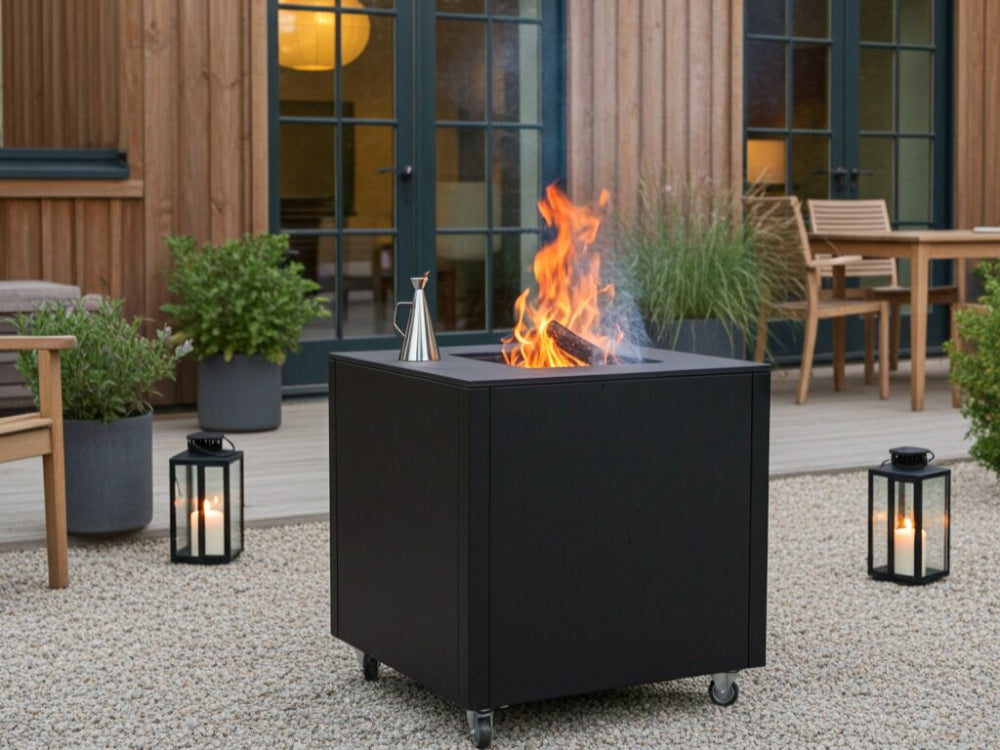
A steel box. A fire. A cooking plate.
But when you're working with open flames, high temperatures, carbon steel and food, the details really matter.
How thick should the cooking plate be? What's a comfortable working height? How does heat from the fire reach the plate? How do you add more firewood while cooking? Where do grease and food scraps go? And what happens to the patio underneath the grill?
Questions like these have shaped the design of the CUBY fire pit grill.
For us, quality isn't about using as much material as possible or making a product heavy for the sake of it.
It's about choosing the right material, the right steel thickness and the right construction for each part of the product.
Here, we'll take a closer look at the technical details and explain why we've built our fire pit grill the way we have.
Why do we use a 12 mm cooking plate?
The cooking plate is one of the most important parts of a fire pit grill.
That's why CUBY has a 12 mm carbon steel cooking plate.
There's a reason for that.
When steel heats up, it absorbs energy. The greater the mass of the cooking plate, the more heat it can store and the less its temperature is affected when, for example, you put cold ingredients on it.
A thick cooking plate therefore has a high thermal mass.
In practice, this means:
- more stable temperatures
- more even heat distribution
- fewer sudden temperature fluctuations
- the ability to cook in different heat zones
- good heat capacity when cooking large amounts of food
- a highly durable cooking plate with a long service life
A thin cooking plate responds quickly to changes in the fire. Its temperature can rise and fall rapidly, and the plate itself is more sensitive to the large temperature differences that naturally occur around an open fire.
With 12 mm carbon steel, the plate takes longer to heat through, but once it's hot, it acts as a substantial heat reservoir.
The CUBY fire pit grill is typically ready for cooking after around 30–60 minutes of heating, depending on the fire, weather and fuel.
So it isn't necessarily the quickest option.
We chose it because we value steady heat, control and good cooking performance.
Different temperatures across the cooking plate are an advantage
A fire pit grill doesn't need to have exactly the same temperature across the entire cooking plate.
Quite the opposite.
The fire is concentrated in the centre, so the area closest to it will usually be hotter than the outer edges.
This creates natural heat zones.
Near the centre, you can use higher heat for:
- meat
- smash burgers
- creating a good sear
- vegetables that need intense heat
Further out on the plate, the lower temperatures can be useful for:
- finishing food gently
- fish
- vegetables
- bread
- keeping cooked food warm
Instead of having just one temperature, you get a large cooking surface with different possibilities.
That requires a plate capable of absorbing and distributing plenty of heat – another reason we chose 12 mm carbon steel.
Why a height of around 80 cm?
A grill's height isn't just about its appearance. It's also about how comfortably you can work.
Our large CUBY fire pit grill is built around an 80 cm high module, giving a cooking plate height of approximately 81.5 cm without wheels.
This puts the cooking surface at a height where you can stand and prepare food without constantly bending down.
That's particularly important when you use the fire pit grill for what it effectively becomes:
an outdoor kitchen.
When you're spending time at the grill, turning burgers, chopping vegetables, using pans or preparing several dishes at once, working height matters much more than it does with a conventional grill where you only open and close the lid occasionally.
If you'd like extra height and more flexibility, you can add wheels. With wheels, the cooking plate sits at approximately 91.5 cm, and the grill is easier to move when needed – for example, around the patio or as part of a larger outdoor kitchen.
We've therefore chosen the height with four things in mind:
ergonomics, function, flexibility and proportions.
The construction beneath the cooking plate matters just as much
The cooking plate is the part you see.
But much of what makes the grill work is underneath it.
The CUBY fire pit grill is made up of several separate components. During assembly, they're fitted in this order:
Fire bowl → drip tray → cooking plate.
This lets each component serve a specific purpose, rather than simply lighting a fire directly inside the steel body.
The fire bowl
The fire burns in a separate insert.
This helps concentrate the flames and heat where they're needed.
The fire bowl also has several ventilation holes that increase the oxygen supply to the fire. This supports more efficient combustion, helps the fire burn steadily and makes it easier to build up the heat needed for the cooking plate.
It's an important detail because a good fire isn't just about how much wood you use – it's also about how effectively air reaches the flames.
Heat travels upwards towards the cooking plate, while the CUBY body provides a supporting structure around the system.
That distinction matters.
We want high heat where the food is cooked – not unnecessary heat throughout the entire outer structure.
Of course, that doesn't mean the sides of a fire pit grill stay cool. You're still dealing with an open fire and very high temperatures, and the grill must always be treated accordingly.
The components are designed to work together so that airflow, combustion and heat distribution help concentrate heat inside the grill and direct it towards the cooking surface.
You need to be able to add firewood while cooking
One of the challenges of cooking over an open fire is that the fire doesn't look after itself.
Wood turns into embers.
Embers gradually lose heat.
And eventually, you need to add more wood.
Ideally, you should be able to do that without dismantling the grill or moving the heavy cooking plate.
That's why there's an opening beneath the grate that allows you to feed more wood into the fire while you're cooking.
On the 80 × 80 cm model, the opening for adding firewood is approximately 10 cm.
This allows you to adjust the fire as you go.
More wood provides more energy.
Less wood produces a gentler heat.
The fire becomes an active part of cooking, rather than simply a heat source you light once and leave alone.
Cleaning needs to be part of the design
Cooking produces grease.
Open fires produce ash.
And a grill that's used will get dirty.
That's why cleaning needs to be considered from the very beginning of the design process.
The principle for the cooking plate is simple:
While the plate is still warm, scrape off food residue and cooking deposits with a stainless steel spatula. Then apply another thin layer of oil.
Over time, many thin layers of oil build up on the carbon steel.
They give the plate its characteristic dark surface, help protect the steel and improve its cooking properties.
In many ways, it's similar to looking after a good cast iron frying pan.
The aim isn't to keep the steel looking brand new.
It's to build up a good cooking surface through use.
Why does placement matter?
A fire pit grill isn't an ordinary piece of garden furniture.
It involves open flames, hot embers, grease, oil and very high temperatures. So choosing where to put it deserves careful thought.
We recommend a stable, level, non-combustible or otherwise suitable surface. If the grill is placed on a timber deck or another sensitive surface, we do not recommend placing it directly on that surface without protection.
And heat isn't the only concern.
Even if the construction limits heat transfer to the ground beneath it, normal use can still involve:
- embers and ash
- grease and oil spills
- food scraps
- rust marks or other material stains
We therefore recommend using a suitable grill mat or other protection against heat and dirt beneath the grill when placing it on timber, composite decking or other sensitive surfaces.
Our aim isn't to demonstrate how close a fire pit grill can be placed to a vulnerable surface. It's to give advice that considers the entire experience of using it – not just heat, but also flames, embers, grease, oil and everyday use.
And one rule always applies, whatever the surface:
A fire pit grill with a live fire must never be left unattended.
Why do we make our grills ourselves?
The CUBY fire pit grill isn't a ready-made product that we buy and put our logo on.
It's developed and manufactured by byJEMA in Denmark.
Making it ourselves matters because design and production are closely connected.
When development and manufacturing happen side by side, we can continually work on:
- tolerances
- material selection
- joints and connections
- bends
- welds
- fit
- prototypes
- improvements
- spare parts
- accessories
It also means that experience from the factory and feedback from customers can go directly back to the people working on the product.
At byJEMA, we handle the entire process, from design to production, in-house at our factory in Denmark.
That matters to us.
Not because being made in Denmark automatically makes a product good.
But because it gives us control over the product we deliver to our customers.
Developed through experience – not just on a computer screen
Developed through experience since 2020
The byJEMA fire pit grill was launched in 2020. Since then, we've continued refining its construction through practical use, experience and ongoing product development.
That means the design hasn't been developed solely on a computer screen. Over the years, we've learned how steel responds to repeated heating and cooling, how the 12 mm cooking plate performs at high temperatures, how best to manage the fire while cooking and which details make a real difference in everyday use.
The grill has been through many hours of:
- cooking
- lighting fires
- heating up and cooling down
- cleaning
- adding firewood
- use in different weather conditions and seasons
And that experience matters.
It's one thing to see how a product works in a technical drawing. It's another to see what happens when there's a large fire inside it, when the cooking plate is fully heated, when you need to add wood halfway through dinner or when lots of people are gathered around the grill.
The CUBY fire pit grill we produce today is therefore the result of years of experience with open-fire cooking, steel construction and practical use.
Experience like that helps a product mature – and means that quality comes from considered choices, not chance.
A fire pit grill should adapt to your needs
We've deliberately designed CUBY as a system rather than a standalone product.
That means there are accessories that let you use the grill in different ways.
For the 80 × 80 cm model, these include:
- lid
- drip tray
- spatula
- oil can
- infrared thermometer
- pizza oven
- grill gloves
- rotisserie
- optional bottom plate and wheels
The grill can also be combined with CUBY outdoor kitchen modules.
The point isn't that everyone needs every accessory.
It's that the grill doesn't have to be a fixed, one-purpose setup.
It can grow and change with the way you use your outdoor kitchen.
Can you buy spare parts?
We think that's a question worth asking before buying something you expect to last for many years.
What happens if a part needs replacing after years of use?
With CUBY, key components are separate parts.
For example, the cooking plate and grate can be purchased separately, and the grill is built from individual components rather than as one sealed unit.
That makes it possible to maintain the product and keep using it instead of automatically replacing the entire grill.
To us, that's part of quality too.
We take food contact seriously
A grill isn't just a steel product.
It's something you use to prepare food.
That's why the materials that come into contact with food must be suitable for that purpose.
The CUBY fire pit grill is approved for food contact, and declarations of conformity are available on request from byJEMA.
[Insert your specific information about registration under the Danish Veterinary and Food Administration's Smiley Scheme and, if applicable, a link to the inspection report here.]
We believe the documentation should be just as carefully considered as the construction itself.
Why customers choose the CUBY fire pit grill from byJEMA
We could have made several parts lighter.
We could have chosen a thinner cooking plate.
We could have used fewer components.
But our goal was never to build the simplest possible fire pit grill.
It was to build one that makes sense when you actually use it.
That's why CUBY offers:
✅ 12 mm carbon steel cooking plate
✅ High thermal mass and stable temperatures
✅ Natural heat zones across the cooking plate
✅ Practical working height
✅ Ability to add firewood while cooking
✅ Separate components for the fire, collection of drips and cooking
✅ Danish design, development and production
✅ Spare parts and the option to replace key components
✅ Wide range of accessories
✅ Approved for food contact
✅ A design developed with long-term use in mind
Thinking of buying a fire pit grill? Ask these questions first
There are plenty of fire pit grills on the market.
They may look similar in photographs.
But what lies beneath the surface can be very different.
Before you choose, we think it's worth asking:
1. What material is the cooking plate made from?
This is where you prepare your food, so the material matters.
2. How thick is the cooking plate?
Thickness makes a big difference to the plate's thermal mass, temperature stability and durability.
3. Are the materials intended for food contact, and is this documented?
Ask for documentation if you're unsure.
4. How do I add more firewood while cooking?
It might seem like a small detail – until you're halfway through preparing a meal.
5. How do I clean the grill?
Don't just consider how it looks. Think about cleaning it the next day, too.
6. How are grease, oil and food scraps handled?
And what does the construction mean for the surface beneath and around the grill?
7. Can I buy spare parts?
A grill designed to last should be possible to maintain and repair.
8. Are there accessories specifically designed for the grill?
That gives you far more options if you want to add to your setup later.
9. Where is the product made?
And does the manufacturer understand how it's constructed?
10. How long has the design been in use?
There's a difference between a newly designed product and one that has been used, tested and refined in real life over a longer period.
You can see quality – but you should feel it when you use the grill
For us, quality isn't just about whether a weld looks neat or the steel looks good when the grill is new.
It's also about the things you notice later.
A steady cooking temperature.
A comfortable working height.
Being able to add more firewood.
A cooking plate that's easy to clean.
The option to replace a component.
Accessories that fit.
And a construction that still makes sense after years of use.
Details like these don't happen by accident.
Quality isn't a matter of luck.
It's thought through.
 International (EUR)
 Denmark (DKK)
 Norway (NOK)
 Sweden (SEK)
 Germany (EUR)
 Austria (EUR)
Leave a comment
This site is protected by hCaptcha and the hCaptcha Privacy Policy and Terms of Service apply.